




ChatGPT can help you learn Chinese in some ways: it answers grammar questions fast, and Voice Mode lets you practice basic conversation. But if you want to use ChatGPT to learn Chinese seriously, you run into two big problems. First, almost nobody sticks with it. You open the app once or twice, then drift away because nothing makes you come back. Second, even if you do stick with it, ChatGPT will not correct your tones, speaks Chinese with an accent, and cannot teach you the cultural nuances that real conversations require. A real teacher gives you both the consistency and the precision that AI Chinese learning cannot match. Try a free trial lesson and feel the difference.
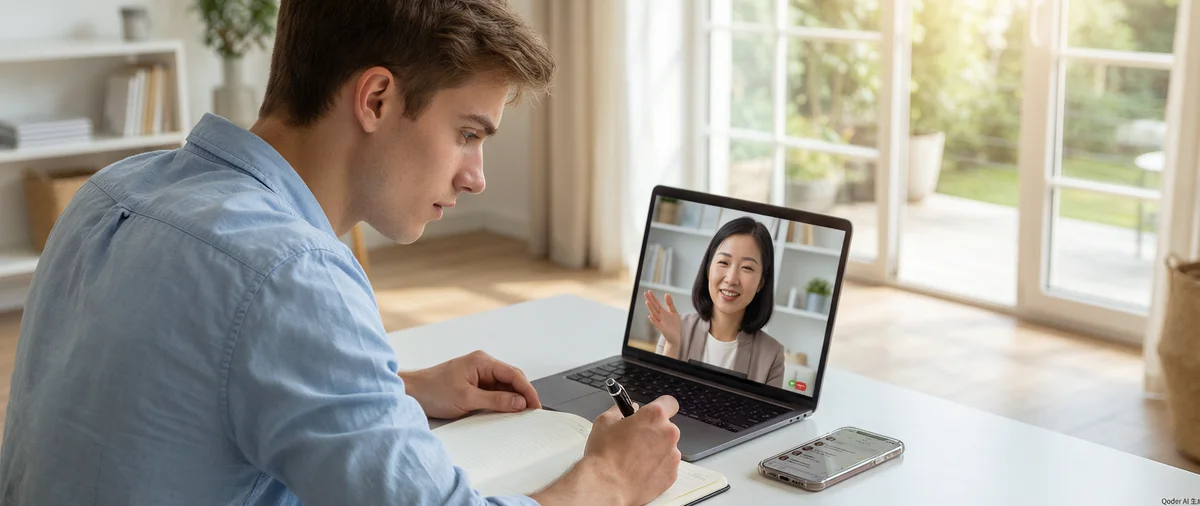
Be honest. How many times have you told yourself you were going to learn Chinese?
You bookmarked a YouTube playlist. You downloaded Duolingo. You even opened ChatGPT, typed “help me learn Chinese,” and got a neat little study plan. Then life happened. A busy week at work. A friend’s birthday dinner. You told yourself you would start Monday. Then next Monday. Then the Monday after that.
Six months later, you still cannot introduce yourself in Chinese. Not because you are bad at languages. Not because the tools were not good enough. Because nobody was waiting for you.
This is what nobody talks about when they compare AI to human teachers. There are actually two problems with using ChatGPT to learn Chinese. The first is that you probably will not stick with it. The second is that even if you do, it cannot do what a real teacher does. Let us walk through both.
Problem One: You Already Know This Cycle
Here is what happens with AI Chinese learning. Almost every time.
Day one: motivated. You open ChatGPT, switch to Voice Mode, say a few phrases in Chinese. It responds. It feels exciting. You tell yourself this time will be different.
Day three: you forget. Or you open the app, but a notification pulls you away. You will do it later.
Day seven: the app is still on your phone, but you have not opened the Chinese conversation in four days. You feel a little guilty, but not enough to change anything.
Day fourteen: you see someone post about learning Chinese on social media. You think about starting again. You do not.
Day thirty: if you are still “learning,” it is passive. You might read a Chinese character in a movie subtitle and recognize it. That is it.
We have seen this pattern with thousands of students at eChineseLearning. They come to us after months, sometimes years, of trying to teach themselves with apps and AI. They are not lazy. They are not unintelligent. They are human. And humans are not designed to learn a tonal language alone on a couch at 11 PM when Netflix is one swipe away.
Why this happens. ChatGPT is perpetually available, which means there is no urgency to start right now. No one notices when you stop. A notification is easy to swipe away. A person waiting for you on a scheduled lesson is not. When you skip, they ask where you were. That accountability is not a burden. It is the reason you show up.
There is no plan, so there is no progress. Every ChatGPT session starts from zero. No curriculum, no review of last week’s mistakes, no sense that you are building toward something. A teacher has a plan. They know what you struggled with and what comes next. You feel progress because there is progress.
Problem Two: Even If You Stick With It, ChatGPT Has Gaps
Let us say you are the rare person who actually uses ChatGPT to learn Chinese every day. Here is what you will run into.
It hears you, but it does not correct you. When you use ChatGPT Chinese practice through Voice Mode, it understands your spoken Chinese well enough to keep a conversation going. But understanding you and correcting you are two different things. If you say 马 (mǎ – horse) with a first tone instead of a third, ChatGPT will likely understand what you meant from context and keep chatting. It will not stop and say “your tone on that word was wrong.” Chinese is a tonal language where 妈 (mā – mother), 麻 (má – hemp), 马 (mǎ – horse), and 骂 (mà – scold) are separated only by pitch. A tool that lets your tone errors slide is not teaching you to speak correctly. It is teaching you to speak incorrectly with confidence.
Its own Chinese has an accent. When ChatGPT speaks Chinese in Voice Mode, the tones are approximate, the rhythm is off. If your primary pronunciation model is an AI with an accent, your own accent will drift toward its patterns rather than toward native speech. You think you are learning how Chinese sounds, but you are learning how an AI approximates Chinese.
Conversations are agreeable, not challenging. ChatGPT is designed to be helpful. It will not push you. It will not say “you used the wrong measure word there” or “that sounds unnatural, try saying it this way.” In a one-on-one Chinese class, the teacher is actively listening for your weak spots and building exercises around them. ChatGPT is responding to what you say. It is a reactive partner, not an active coach. You practice understanding Chinese more than producing it.
Cultural nuance is thin. ChatGPT can translate 为什么 (wèishénme – why) and explain grammar rules. But if your Chinese colleague says 还行 (hái xíng – it is okay) in response to your proposal, ChatGPT will not help you read the room. In Chinese professional culture, 还行 often means “I have concerns but I will not say them directly.” You learn that from interacting with people, not from chatbots.
These gaps are not small for Chinese specifically. In a language where a wrong tone changes the word entirely, and where social context changes the meaning of what was said, the limitations of AI for learning Chinese are not nitpicks. They are the difference between being understood and being confident. When people ask can AI replace a Chinese teacher, these are the gaps they do not see.
What ChatGPT Actually Does Well
To be fair, ChatGPT has real strengths for Chinese learning.
It answers questions fast. Confused about the difference between 了 (le) and 的 (de)? Ask ChatGPT, get an explanation in seconds. That is useful for anyone exploring ChatGPT learn Chinese methods.
Voice Mode lets you practice speaking. The 2026 version with real-time emotion recognition is better than ever. You can have a basic conversation, ask it to slow down, switch topics. The latency is low enough that it feels somewhat natural.
Vocabulary and reading support. Paste a Chinese article, ask for explanations, get example sentences. Faster than any textbook.
It is available around the clock. No scheduling, no commute. Open the app, start talking.
These are genuine benefits. If you are someone who uses ChatGPT consistently for Chinese practice, you will pick up vocabulary and gain some comfort with sentence structure. The question is whether that is enough. For most learners, it is not.
What a Real Teacher Does That AI Cannot
After 20 years of teaching students from over 100 countries, we have seen what actually gets people speaking Chinese. It comes down to two things: showing up, and getting corrected.
Immediate, specific correction. A teacher hears you say something and stops you right there. Not after the paragraph. Right when it happens, when your brain can still connect the correction to the attempt. You say 马 (mǎ – horse) with a rising tone, and a teacher says “try that again, feel the dip.” That physical, immediate feedback is how your brain rewires the pattern. Tone practice with someone who can hear the exact pitch you missed is fundamentally different from talking into an app and hoping for the best.
Diagnostic teaching. ChatGPT responds to what you say. A teacher figures out why you said it wrong. When a student keeps mixing up tone patterns, a teacher identifies the root: they are mentally translating English structures before speaking, which leaves no cognitive space for tones. The fix is not more corrections. It is changing how they prepare to speak. ChatGPT cannot do that because it does not have a teaching framework. It has a language model.
Sessions where you speak, not listen. In a one-on-one lesson, you talk 70-80% of the time. The teacher creates situations that force you to produce language: describe what happened, negotiate a price, explain a problem. In a ChatGPT session, you listen more than you speak. If you want to actually converse in Chinese, you need practice producing sentences under pressure, not just recognizing them.
Someone who will not let you quit. A teacher texts you when you miss a class. They ask how your business trip went in Chinese. They remind you why you started learning in the first place. AI cannot care about you. It can simulate warmth, but it does not notice when you disappear. That human accountability is what turns wanting to learn Chinese into actually speaking it.
How to Use Both
The best way to learn Chinese speaking is not choosing between AI and teachers. It is using each for what it does best.
Use ChatGPT for: vocabulary review before a lesson, casual conversation practice when you cannot schedule a session, reading comprehension, and quick grammar questions. Think of it as your input engine and low-stakes practice partner.
Use a real teacher for: tone correction, conversation that pushes you beyond your comfort zone, and diagnostic feedback that catches problems you cannot hear yourself.
A practical split: spend 10-15 minutes with AI for vocabulary or a casual chat, then bring that preparation into a structured lesson where you speak, get corrected, and practice the specific patterns your teacher has identified. If you do not yet have someone to practice with, try these solo speaking methods first, then bring what you have learned to a real teacher who can take you further.
The key insight: AI gives you more time with Chinese. A teacher gives you better time with Chinese. Both matter. But without someone making you show up, the “more time” rarely happens. And without precise correction, the time you do spend does not stick.
Your Next Step
You have been wanting to learn Chinese for a while now. You have tried apps, AI, and good intentions. The intention is real. The results are not.
The difference is not a better tool. The difference is a person. Someone who shows up for you, so you show up for yourself. And someone who corrects you when you need it, so the time you spend actually counts. Book a free 30-minute trial lesson. No commitment, no pressure. Just 30 minutes of actually speaking Chinese with someone who will help you get it right.
eChineseLearning | Founded in 2006 | Trusted by students from 100+ countries | Chinese speaking skills built lesson by lesson
Common Questions About AI and Learning Chinese
Can ChatGPT teach me Chinese on its own?
It can help you practice vocabulary and reading. But most people who try AI learn Chinese with only ChatGPT do not stick with it. And even those who do run into problems: ChatGPT will not correct your tones, it speaks Chinese with an accent, and it cannot diagnose why you keep making the same mistakes.
Is ChatGPT Voice Mode useful for Chinese speaking practice?
For basic conversation flow, yes. For accurate tones, no. ChatGPT understands you even when your tones are wrong, so you keep talking without getting corrected. In Chinese, where 马 (mǎ – horse) and 妈 (mā – mother) differ only by pitch, practicing without tone feedback means practicing mistakes.
Can AI replace a Chinese teacher?
Not for spoken Chinese. There are two reasons: most people cannot stick with AI alone, and even those who do miss out on tone correction, diagnostic teaching, and cultural nuance that a real teacher provides. If you are wondering can AI replace a Chinese teacher, the practical answer is no. AI is a good supplement, but not a replacement.
How do I stay motivated to learn Chinese?
Motivation comes from progress, and progress comes from consistency. A scheduled lesson with a real person creates a commitment that is hard to skip. Over time, seeing yourself improve is what keeps you going. Self-teaching with AI rarely provides that loop.
What is the fastest way to start speaking Chinese?
Start talking to a person. Not a bot. A real teacher who can hear your tones, correct your sentences, and push you to say more than you think you can. Try a free lesson and you will feel the difference in the first five minutes.