




The Mid-Autumn Festival, also called the Moon Festival, falls on the 15th day of the eighth lunar month, usually in late September or early October. Every year my students ask me what Chinese people actually do on this day, so let me walk you through the customs I grew up celebrating. Watch this short video lesson for an overview first.
Eating Mooncakes and the Family Reunion Dinner
The custom I look forward to most is gathering with family for the reunion dinner (团圆饭, tuányuán fàn). Much like the Spring Festival, this meal brings everyone home, and mooncakes (月饼, yuèbǐng) are always on the table. These round pastries mirror the full moon, so they have come to symbolize unity and completeness.
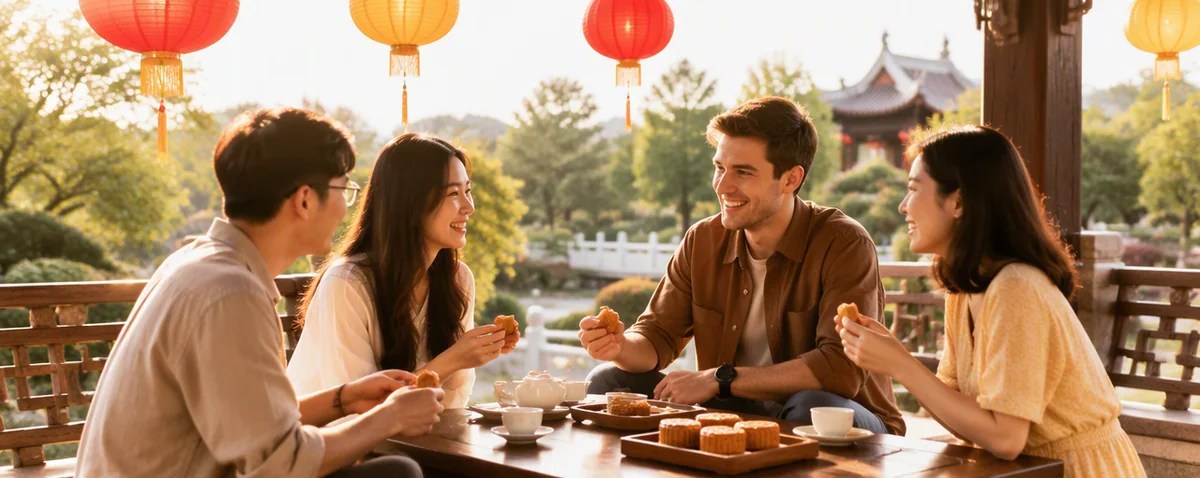 Conceptual illustration of friends sharing mooncakes and tea under lanterns during the Mid-Autumn Festival
Families exchange mooncakes with relatives, friends, and colleagues as a way of sharing blessings. The fillings vary by region, but the classics are:
- 莲蓉 (lián róng) – lotus seed paste
- 红豆沙 (hóng dòu shā) – red bean paste
- 五仁馅 (wǔ rén xiàn) – five-nuts filling
- 咸蛋黄 (xián dànhuáng) – salted egg yolk
Listen and repeat: the word for mooncake and a sentence my students love to practice.
Want to know why mooncakes became the symbol of this day? It all started with a clever legend about a secret message, which we explore in the myths section below.
Admiring the Full Moon with the Family
On the night of the festival, families gather outdoors to admire the full moon, believed to be at its brightest of the year. The moon symbolizes completeness, and moon gazing carries a deeper meaning: it is a way of sending thoughts to loved ones far away, since everyone looks at the same moon. This is why the festival is so closely tied to the idea of reunion. Listen and repeat: the word for admiring the moon.
For more on this beautiful idea, you can explore our one-on-one Chinese speaking classes, where teachers bring customs like these to life.
Lighting Lanterns and Watching Fire Dragon Dances
Beyond mooncakes and the moon, lanterns are a signature part of the celebration. Across southern China, people hang lanterns outside their homes, and children carry them in parades. In some areas, families float lanterns on rivers, sending their wishes out into the night. These lanterns symbolize the guiding light that keeps families together and prosperous. The most spectacular lantern custom of all is Hong Kong’s Tai Hang fire dragon dance (大坑舞火龙, dà kēng wǔ huǒ lóng). For more than a century, residents of the Tai Hang neighborhood have paraded a 67-meter dragon made of straw and burning incense through the streets on the three nights around the festival, believing it drives away bad luck and brings good fortune. In 2011 it was inscribed on China’s national intangible cultural heritage list. Hong Kong also hosts some of the country’s most famous Mid-Autumn lantern displays.
A Playful Courting Custom of the Dong People
One of the most charming regional customs belongs to the Dong ethnic group (侗族, dòng zú) in southwestern China, mainly in Hunan’s Xinhuang area and parts of Guizhou. Young unmarried women practice “stealing moonlit vegetables” (偷月亮菜, tōu yuè liàng cài). According to legend, the Moon Fairy sprinkles dew on the world on this night, so it is considered a blessing to pick vegetables from a neighbor’s garden. A single woman will slip into the garden of the man she fancies, “steal” vegetables like green onions or double-grown beans, and call out so he knows it was her, as a playful sign of affection. These regional practices show how one festival can take many beautiful shapes. If you enjoy learning about Chinese culture through stories like this, our guide to the benefits of studying Chinese is a good read.
Myths Behind the Festival: Chang’e and the Jade Rabbit
The festival is also rich with legends, the most famous being the story of Chang’e (嫦娥, Cháng’é), the moon goddess. According to the tale, Chang’e drank an elixir of immortality and floated to the moon, leaving her husband Hou Yi behind. Heartbroken, Hou Yi offered her favorite foods under the full moon each year, and people continue this tradition to honor her. The Jade Rabbit (玉兔, Yù tù) is said to live with her, pounding herbs to make the elixir of life. If you love these legends, do not miss three classic Mid-Autumn Festival legends you must know.
How Other Countries Celebrate the Moon Festival
The festival extends far beyond China. Vietnam, South Korea, Japan, and Singapore all mark the occasion with similar customs:
| Country | Festival Name | Key Customs |
|---|---|---|
| Vietnam | Tet Trung Thu | A celebration for children with lantern parades and lion dances |
| South Korea | Chuseok | Honoring ancestors with a feast of traditional foods |
| Japan | Tsukimi | Moon viewing with offerings of rice dumplings and seasonal plants |
| Singapore | Mid-Autumn Festival | Lantern displays and mooncake sharing in parks |
You can read more about the deeper heritage in our article on everyday Chinese phrases for self-introduction, which pairs well with your festival vocabulary.
Practice a Mid-Autumn Conversation
Now that you know the customs, let us practice a real conversation. Read each line below, then listen to the audio to check your pronunciation.
Practicing sentences out loud is one of the quickest ways to make vocabulary stick. If you would like a teacher to listen and correct your pronunciation, our live 1-on-1 lessons are built for exactly that.
Common Questions About the Mid-Autumn Festival
Practice Your Chinese This Festival Season
The most enjoyable way to make these customs and phrases yours is to practice them with a live teacher who can guide your tones and help you build real conversation skills. At eChineseLearning, our teachers have been helping students explore Chinese culture and language since 2006, with learners from over 100 countries. Book a free 30-minute trial lesson and start your journey today. As a bonus, watch this lesson answer video to review what you have learned:
Founded in 2006 | Serving 100+ Countries
Wishing us a long life to share the graceful moonlight, though housands of miles apart. 但愿人长久,千里共婵娟.