




The Fèng Huáng (凤凰, fèng huáng – Chinese phoenix) and the Western Phoenix are often confused as the same mythical bird, but they are fundamentally different creatures from separate cultural traditions. The Fèng Huáng is a Chinese mythical bird symbolizing virtue, grace, and marital harmony, while the Western Phoenix is a fire bird known for death and rebirth through flames. Understanding these differences will deepen your appreciation of Chinese culture and help you avoid a common translation trap.
If you are interested in exploring more about Chinese culture and language, you can book a free 30-minute trial lesson with eChineseLearning and learn Chinese one-on-one with a professional teacher.
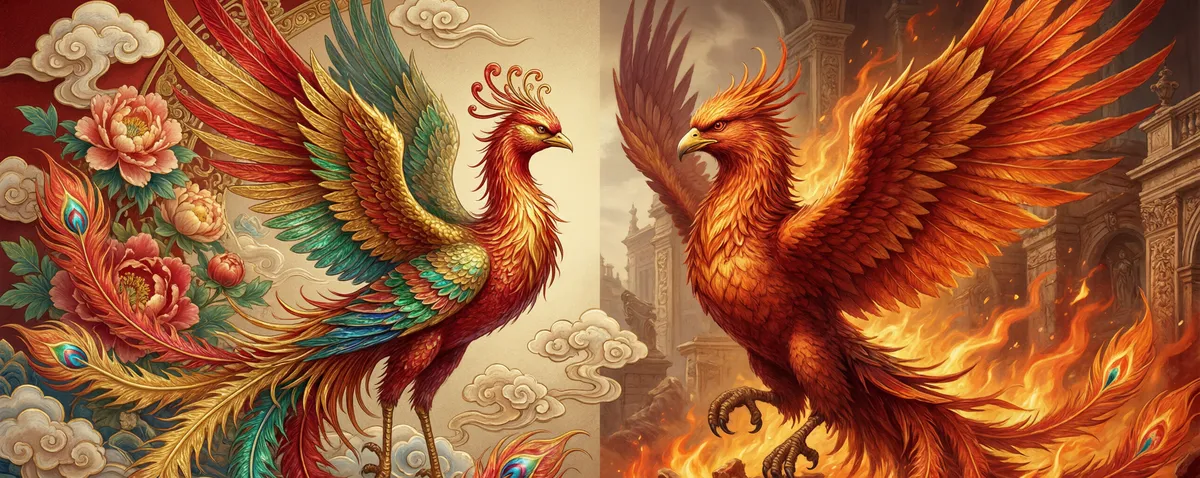 Conceptual illustration of the Feng Huang and Western Phoenix cultural differences
1. Origin Mythology: Ancient China vs Ancient Egypt and Greece
The Fèng Huáng’s Chinese Origins
The Fèng Huáng (凤凰, fèng huáng) is one of the Four Supernatural Spirits (四灵, sì líng) in Chinese mythology, alongside the dragon (龙, lóng), the qilin (麒麟, qí lín), and the tortoise (龟, guī). Its earliest records date back to the Shān Hǎi Jīng (山海经, shān hǎi jīng – Classic of Mountains and Seas), a text compiled over 2,000 years ago.
In Chinese tradition, the Fèng Huáng is considered the king of all birds (百鸟之王, bǎi niǎo zhī wáng). Unlike the Phoenix, which is associated with fire and destruction, the Fèng Huáng appears only during times of peace and prosperity, making it a symbol of good governance and harmony. Ancient Chinese texts record that when a ruler governed with virtue and justice, the Fèng Huáng would descend to grace the land, a sign of divine approval.
The Phoenix’s Western Origins
The Western Phoenix originates from ancient Egyptian mythology, where it was known as the Bennu bird, a sacred creature associated with Ra, the sun god, and the flooding of the Nile. The Greeks later adapted this myth, calling it the Phoinix (Φοῖνιξ), a bird that lived for 500 years before burning itself on a funeral pyre and being reborn from the ashes.
The Greek historian Herodotus (5th century BCE) provided one of the earliest written descriptions of the Phoenix in his work The Histories, cementing its association with fire, death, and resurrection in Western culture. The Roman poet Ovid (43 BCE to 17 CE) further popularized the Phoenix in his Metamorphoses, describing its rebirth cycle in vivid detail.
2. Gender Structure: Two Birds vs Single Entity
One of the most important yet overlooked differences is the gender structure.
Fèng Huáng: Two Birds in One Name
The name Fèng Huáng (凤凰) actually refers to two separate birds:
- Fèng (凤, fèng): The male bird
- Huáng (凰, huáng): The female bird
Together, they represent yīn and yáng (阴阳, yīn yáng), the fundamental duality of masculine and feminine forces in Chinese philosophy. This dual-gender nature is why the Fèng Huáng is often associated with marital harmony and conjugal bliss.
During the Han Dynasty (汉朝, hàn cháo, 206 BCE to 220 CE), the Fèng Huáng became paired with the dragon as a symbol of the empress, while the dragon represented the emperor. This pairing, lóng fèng chéng xiáng (龙凤呈祥, lóng fèng chéng xiáng – the dragon and phoenix bring auspiciousness), remains one of the most popular motifs in Chinese weddings today. You will often see dragon-and-phoenix patterns embroidered on wedding dresses, carved on furniture, and painted on ceremonial decorations.
Phoenix: A Single Bird
The Western Phoenix is a single entity with no gender duality. It is one bird that lives, dies, and is reborn as itself. There is no concept of a male and female Phoenix forming a pair, and the Phoenix has no association with marital symbolism in Western culture.
3. Symbolism: Virtue and Harmony vs Death and Rebirth
Fèng Huáng Symbolism
The Fèng Huáng represents a set of virtues central to Chinese philosophical thought:
- Virtue and moral integrity (美德, měi dé): The Fèng Huáng only appears when the world is governed by moral leaders
- Grace and elegance (优雅, yōu yǎ): Its movements and appearance embody refined beauty
- Marital harmony (婚姻和谐, hūn yīn hé xié): The dual-gender nature symbolizes the ideal union of opposites
- Peace and prosperity (和平繁荣, hé píng fán róng): Its presence signals an era of good fortune
- The empress and feminine power in imperial China: From the Han Dynasty onward, the Fèng Huáng was the exclusive emblem of the empress
The Fèng Huáng does not die and is not reborn. It is an eternal being that simply appears or disappears based on the moral state of the world. When a ruler is just and virtuous, the Fèng Huáng graces the land with its presence; when corruption spreads, it retreats from view.
Phoenix Symbolism
The Phoenix represents a different set of themes:
- Death and resurrection: The Phoenix dies by fire and is born again from its own ashes
- Fire and transformation: Flames are central to its identity, not peripheral
- Eternal renewal and cycles of life: The Phoenix embodies the idea that endings are also beginnings
- Resilience and the triumph over destruction: The Phoenix rises stronger after being consumed by fire
The Phoenix’s symbolism is deeply tied to the idea that from ashes, new life emerges. This concept has been adopted by many Western cultures, religions, and literary traditions as a metaphor for overcoming adversity and starting anew.
4. Life Cycle: Eternal vs Cyclical Death and Rebirth
Fèng Huáng: Eternal Existence
The Fèng Huáng does not have a life cycle of death and rebirth. It is considered an immortal being that exists eternally. It may choose to appear or hide, but it does not die. This is perhaps the single most fundamental difference from the Western Phoenix.
In Chinese texts, the Fèng Huáng nests only in the wú tóng tree (梧桐树, wú tóng shù – Chinese parasol tree). It eats only bamboo seeds (竹实, zhú shí) and drinks from pure springs (清泉, qīng quán), reflecting its association with purity, restraint, and high moral standards. According to legend, the Fèng Huáng will not land on any other tree, eat any other food, or drink from any impure water source.
Phoenix: The 500-Year Rebirth Cycle
The Western Phoenix has one of the most dramatic life cycles in all of mythology:
- It lives for 500 years (some ancient sources cite 1,461 years)
- When its time comes, it builds a nest of aromatic branches and spices: frankincense, myrrh, and cedar
- It sets itself on fire, allowing the flames to consume its body
- From the ashes, a new Phoenix emerges
- The new Phoenix gathers the remains of its predecessor, encases them in an egg of myrrh, and carries them to the altar of the sun god in Heliopolis
- The cycle begins again
This rebirth cycle is the Phoenix’s defining characteristic and has absolutely no equivalent in the Fèng Huáng mythology. Any reference to the Fèng Huáng “rising from ashes” is a modern misattribution borrowed from the Western Phoenix.
5. Physical Appearance: Composite Beauty vs Fire Bird
Fèng Huáng: A Composite of Many Birds
The Fèng Huáng is described in classical Chinese texts as a composite creature, combining features of multiple birds and animals, each carrying symbolic meaning:
| Body Part | Source Animal | Chinese | Symbolism |
|---|---|---|---|
| Head | Pheasant | 野鸡 (yě jī) | Dignity |
| Beak | Swallow | 燕子 (yàn zi) | Eloquence |
| Eyes | Parrot | 鹦鹉 (yīng wǔ) | Vision |
| Chest | Swan | 天鹅 (tiān é) | Purity |
| Legs | Crane | 鹤 (hè) | Elegance |
| Tail | Peacock | 孔雀 (kǒng què) | Beauty |
The Fèng Huáng’s feathers are said to contain five colors (五色, wǔ sè), representing the five Confucian virtues: benevolence (仁, rén), righteousness (义, yì), wisdom (智, zhì), propriety (礼, lǐ), and trust (信, xìn). This multi-colored, composite appearance makes the Fèng Huáng a visual embodiment of moral excellence.
Phoenix: A Fire Bird
The Western Phoenix is typically depicted as a large eagle-like or heron-like bird with brilliant red, gold, and orange plumage, evoking flames and sunlight. Its appearance is singular and unified, not a composite of multiple creatures. The Phoenix’s visual identity is inseparable from fire: it glows, it burns, and it is reborn in light.
6. Cultural Role: Imperial China vs Western Literature
Fèng Huáng in Chinese Culture
The Fèng Huáng plays a central role in Chinese culture that spans over two millennia:
- Imperial symbol: From the Han Dynasty onward, the Fèng Huáng represented the empress. During the Ming Dynasty (明朝, míng cháo, 1368 to 1644) and Qing Dynasty (清朝, qīng cháo, 1644 to 1912), the Fèng Huáng motif was exclusively reserved for imperial use
- Wedding motif: The phrase fèng huáng yú fēi (凤凰于飞, fèng huáng yú fēi – phoenixes flying together) symbolizes a harmonious marriage and is still used in modern Chinese wedding ceremonies
- Idioms (成语, chéng yǔ): The Fèng Huáng appears in numerous four-character idioms that are part of everyday Chinese vocabulary
- Poetry: The modern Chinese poet Guō Mòruò (郭沫若, guō mò ruò) wrote the famous poem “Fèng Huáng Níe Pán (凤凰涅槃, fèng huáng niè pán)” in 1920, adapting the Western Phoenix rebirth concept into the Chinese Fèng Huáng to symbolize China’s cultural and political renewal
The interesting paradox is that Guō Mòruò’s poem borrowed the Phoenix’s rebirth concept and applied it to the Fèng Huáng. This single literary work is largely responsible for why the two birds are so often confused today. The phrase fèng huáng niè pán (凤凰涅槃), literally “Fèng Huáng nirvana,” has since entered common Chinese usage, even though the original Fèng Huáng mythology contains no rebirth element whatsoever.
Phoenix in Western Culture
The Phoenix appears throughout Western literature and culture across millennia:
- Greek and Roman mythology: Described by Herodotus in The Histories, Ovid in Metamorphoses, and Pliny the Elder in Natural History
- Christianity: Early Christian writers adopted the Phoenix as a symbol of Christ’s resurrection and the promise of eternal life
- Modern literature: Appears in works from Dante’s Inferno to J.K. Rowling’s Harry Potter series
- Popular culture: Used as a symbol of resilience, renewal, and transformation in city emblems and sports team logos
7. Common Chinese Idioms Featuring Fèng Huáng
If you are studying Chinese, knowing these idioms will enrich your vocabulary and help you understand cultural references:
lóng fèng chéng xiáng
龙凤呈祥
The dragon and phoenix bring auspiciousness, the most common wedding blessing in Chinese culture
fèng huáng yú fēi
凤凰于飞
Phoenixes flying together, symbolizes a harmonious marriage
fèng huáng niè pán
凤凰涅槃
Phoenix nirvana, means rising from adversity (borrowed from Western Phoenix concept)
bǎi niǎo cháo fèng
百鸟朝凤
A hundred birds paying homage to the phoenix, means a person of great talent or virtue is recognized by many
How to Avoid the Common Translation Trap
When translating between Chinese and English, keep these guidelines in mind:
- Do not automatically translate Fèng Huáng as “Phoenix”, as this obscures the important cultural differences
- Do use “Fèng Huáng” or “Chinese Feng Huang” and briefly explain the distinction when the context allows
- Do note that the Western Phoenix concept of death and rebirth does not apply to the Fèng Huáng
Understanding this distinction shows cultural awareness and is especially important if you are doing business in China or studying Chinese language and culture seriously.
Summary: Fèng Huáng vs Phoenix at a Glance
| Feature | Fèng Huáng (凤凰) | Phoenix |
|---|---|---|
| Origin | Ancient China (Shān Hǎi Jīng) | Ancient Egypt and Greece |
| Gender | Dual: Fèng (male) + Huáng (female) | Single entity |
| Symbolism | Virtue, harmony, marital bliss | Death, rebirth, fire |
| Life Cycle | Eternal, does not die | Dies and is reborn every 500 years |
| Appearance | Composite of multiple birds | Eagle/heron-like fire bird |
| Cultural Role | Imperial emblem, wedding motif | Literary symbol of resurrection |
| Rebirth | No (original mythology) | Yes, central defining feature |
| Fire | No association with fire | Fire is central to its identity |
FAQ
1. Is the Chinese Fèng Huáng the same as the Western Phoenix?
No. The Fèng Huáng (凤凰) is a Chinese mythical bird symbolizing virtue and harmony, while the Phoenix is a Western fire bird associated with death and rebirth. They come from different cultural traditions and have different characteristics. The confusion stems from inaccurate English translations that labeled the Fèng Huáng as the “Chinese phoenix.”
2. Why is the Fèng Huáng often called the “Chinese Phoenix”?
The term “Chinese phoenix” is a convenient but inaccurate translation. Western visitors to China saw a majestic mythical bird and equated it with their own Phoenix. The modern poet Guō Mòruò’s poem “Fèng Huáng Níe Pán” (凤凰涅槃) further blurred the lines by borrowing the Phoenix’s rebirth concept and applying it to the Fèng Huáng.
3. What does the Fèng Huáng symbolize in Chinese culture?
The Fèng Huáng symbolizes virtue (美德, měi dé), grace (优雅, yōu yǎ), marital harmony (婚姻和谐, hūn yīn hé xié), and peace (和平, hé píng). It was historically the symbol of the empress, paired with the dragon as the emperor’s symbol. It also represents the five Confucian virtues: benevolence, righteousness, wisdom, propriety, and trust.
4. Does the Fèng Huáng die and come back to life?
No. In original Chinese mythology, the Fèng Huáng is an eternal being. It does not die or experience rebirth. The rebirth concept was borrowed from the Western Phoenix through Guō Mòruò’s 1920 poem “Fèng Huáng Níe Pán.”
5. How do you write Fèng Huáng in Chinese characters?
Fèng Huáng is written as 凤凰 (fèng huáng). The first character 凤 (fèng) represents the male bird, and the second character 凰 (huáng) represents the female bird. Together, they embody the yīn-yáng (阴阳) duality central to Chinese philosophy.
6. What is the difference between the Fèng Huáng and the dragon in Chinese culture?
The Fèng Huáng and the dragon (龙, lóng) are both among the Four Supernatural Spirits (四灵, sì líng) in Chinese mythology. Historically, the dragon represented the emperor and the Fèng Huáng represented the empress. Together, they form the paired motif lóng fèng chéng xiáng (龙凤呈祥), symbolizing marital harmony and auspiciousness.
7. What tree does the Fèng Huáng nest in?
According to Chinese legend, the Fèng Huáng nests only in the wú tóng tree (梧桐树, wú tóng shù), the Chinese parasol tree. It eats only bamboo seeds (竹实, zhú shí) and drinks from pure springs (清泉, qīng quán), reflecting its association with purity and high moral standards.
8. Can I learn more about Chinese mythology through Chinese language lessons?
Yes. You can book a free 30-minute trial lesson with eChineseLearning. Our professional teachers will help you explore Chinese culture while improving your language skills. With our one-on-one teaching model, you will learn at your own pace with personalized guidance.
eChineseLearning has been teaching Chinese online since 2006, serving students from over 100 countries. Our one-on-one Chinese speaking classes are available 24/7. Your first lesson is on us: no cost, no commitment. If you are not satisfied with a lesson, it is free. You can book your free trial lesson today and start exploring Chinese culture through personalized, one-on-one instruction.